Last updated: February 2, 2026
Examining the features and formation of sedimentary rock layers.
The Earth's crust is composed of vast sequences of sedimentary rock layers that contain fossils and structures. This page examines key features of the sedimentary record and what they indicate about depositional environments.
The Earth's crust is composed of vast sequences of sedimentary rock layers, often thousands of meters thick. These layers, forming the geological column, contain fossils and structures that geologists interpret as a record of Earth's history.
What do the thickness, ordering, delicate structures, and chemical signatures found within sedimentary rocks tell us about their formation?
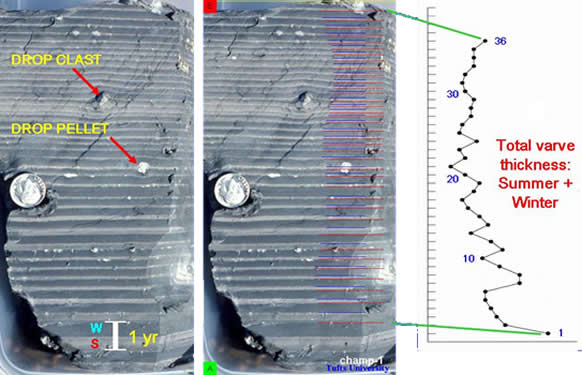
Varves are pairs of sedimentary layers (laminae) that are interpreted as being deposited annually, typically in lakes or quiet marine environments. A common type consists of a lighter, coarser layer deposited during spring/summer runoff and a darker, finer layer deposited during winter when the water body may freeze or be calm.
Formations like the Green River Formation in North America contain millions of such couplets, interpreted as indicating deposition over extended timeframes.
Millions of distinct layers indicate extended depositional timeframes, with each layer pair representing seasonal or annual deposition cycles in quiet water environments.
Sedimentary rocks often preserve delicate structures that indicate specific depositional conditions, often requiring time and periods of subaerial exposure (exposure to air) or calm water.
The presence of these features between layers, and often repeated many times throughout thick rock sequences, is interpreted as indicating cycles of deposition, exposure/calm conditions, and further deposition.
The fossil record exhibits a pattern of faunal succession, where different types of organisms appear in a consistent order through the rock layers. Certain forms are found in lower layers, while others are found in higher layers.
The fossil record displays consistent patterns in organism distribution across rock sequences.
(See also: Fossil Record Sorting for a more detailed discussion.)
These patterns in fossil distribution are documented in the stratigraphic sequence.
The chemical composition of sedimentary rocks provides clues about their formation environment.
These geochemical and lithological features point to diverse processes and environments.
The sedimentary record provides detailed information about past environments and processes.
Key features include:
The sedimentary record contains information about past environments and depositional processes.