Documented examples of new species formation through natural processes.
What is Speciation?
Speciation is the formation of new species - the evolutionary process by which populations evolve to become distinct species. Scientists have directly observed and documented speciation occurring in both field and laboratory settings.
Speciation occurs when populations become reproductively isolated and diverge genetically until they can no longer interbreed successfully. The key modes include:
A common claim is that speciation requires millions of years and cannot be observed directly. The evidence contradicts this. Multiple speciation events have been documented within decades or even generations.
Galapagos "Big Bird" Lineage (2 Generations)
In 1981, a male Geospiza conirostris from Española Island arrived on Daphne Major and mated with a local G. fortis female.
The hybrid offspring bred only among themselves, establishing reproductive isolation within two generations.
The lineage persists today as approximately 30 individuals that do not interbreed with other finch species on the island.
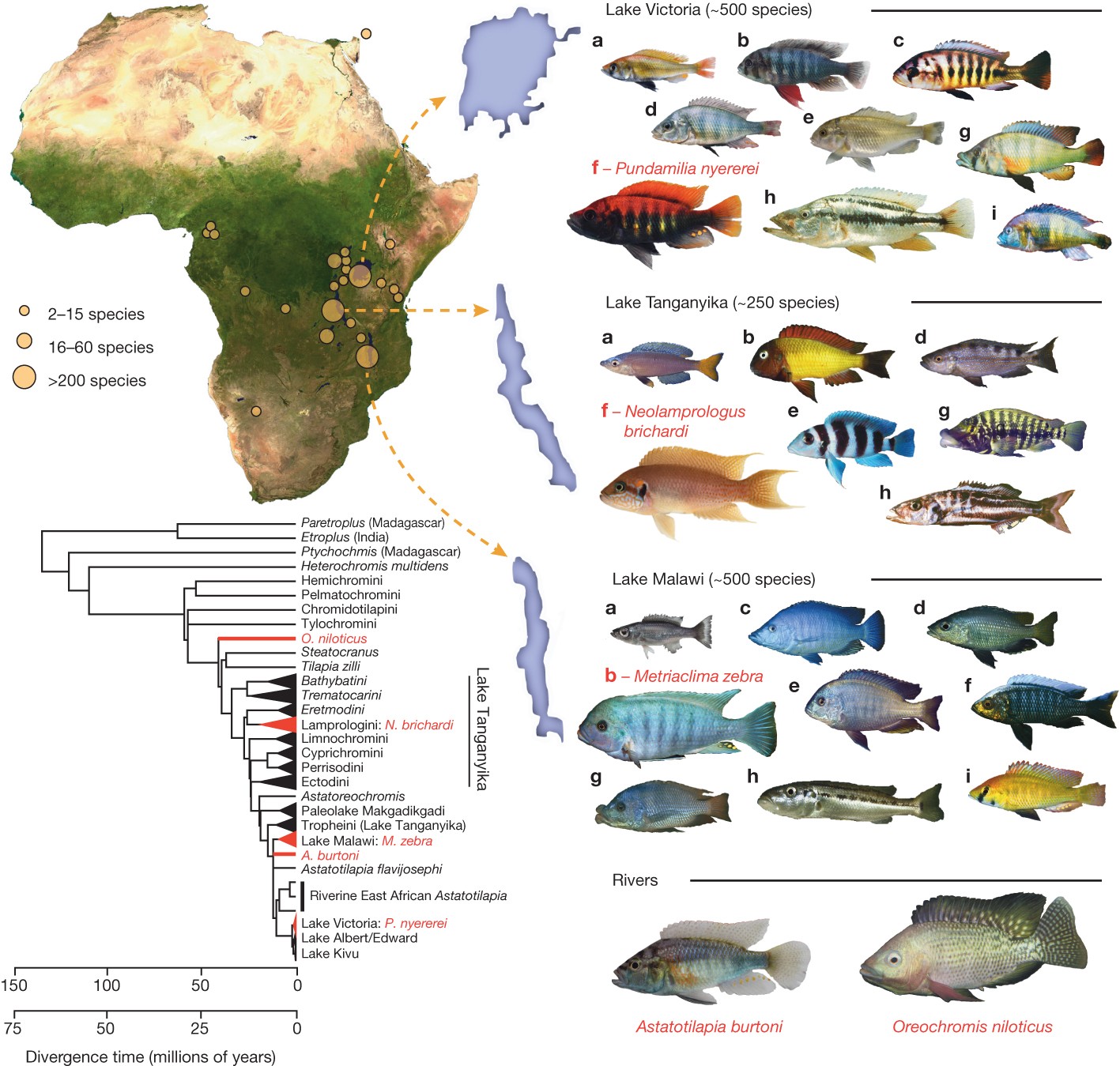
Lake Victoria dried up completely 15,000-17,000 years ago, then refilled.
The lake now contains over 500 endemic cichlid species that evolved from a few colonizing ancestors.
Genetic analysis confirms rapid speciation occurred entirely within the post-refill period.
This represents one of the most rapid adaptive radiations documented in vertebrates.
Caribbean Anolis Radiation
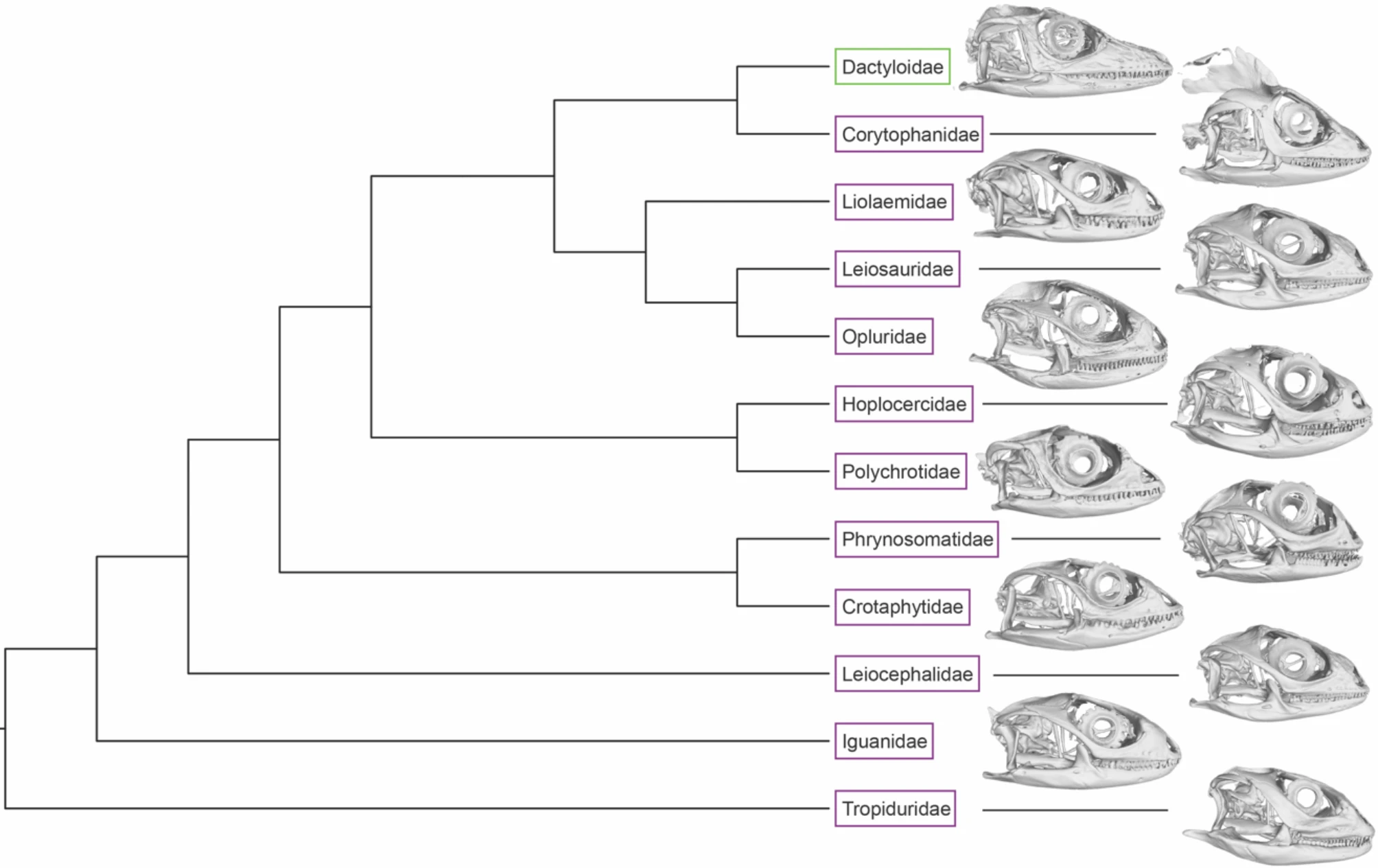
Phylogeny of all Iguania families included in the study with a lateral view skull representative for each. Dactyloidae, indicated by a green box, is comprised of a single genus, Anolis, with over 400 recognized species. 11 relative families of Anolis are indicated with purple boxes.
DNA evidence shows 40+ million years of adaptive radiation across Caribbean islands.
Phylogenetic analysis reveals complex branching patterns over extended timeframes.
Molecular clock data consistently indicates speciation events millions of years old.
This process requires time and natural variation to produce reproductive isolation.
Sexual Selection and Mate Choice
Different mating preferences can drive populations apart even without geographic barriers.
Observed in cichlid fish, where females prefer males with specific coloration patterns.
Over time, preference and trait co-evolve, creating reproductive isolation.
Ecological Specialization
Populations adapting to different environments gradually become incompatible.
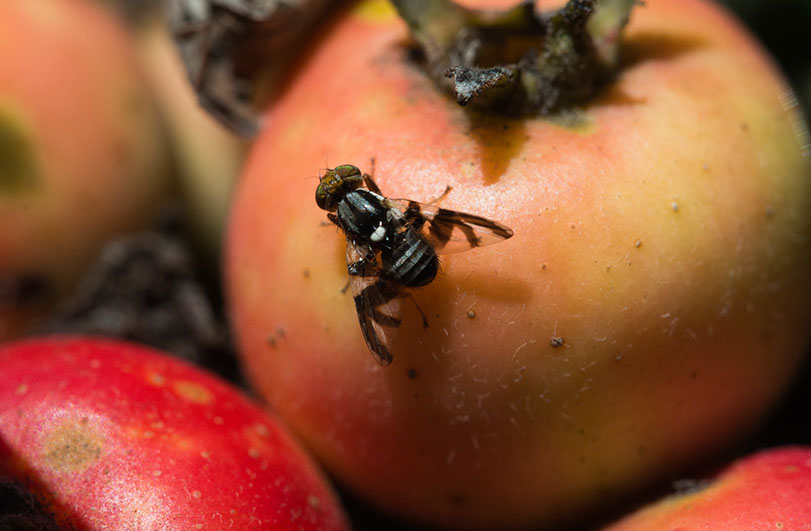
Host-plant specialization in insects frequently leads to reproductive isolation.
Natural selection alone drives the process.
Created Kinds and Baraminology
Young Earth Creationists (YECs) accept that speciation occurs but maintain that organisms remain within fixed "created kinds." This framework, called baraminology (from Hebrew bara "create" + min "kind"), attempts to define the boundaries of variation.
The YEC Position
YECs accept extensive speciation and diversification within created kinds. They do not argue for fixity of species.
A "baramin" or "kind" typically corresponds to the family level in modern taxonomy—for example, all canids (dogs, wolves, foxes, coyotes) are considered one kind.
The primary criterion for determining kinds is hybridization: if two organisms can produce offspring, they belong to the same kind.
YECs argue that while variation occurs, organisms cannot cross the boundaries between kinds—dogs will always produce dogs, not cats.
The scientific community does not accept baraminology as a valid framework for several reasons:
Inconsistent definitions: The boundaries of "kinds" shift depending on context. Creationists accept genetic similarity as evidence of common ancestry for dogs and wolves but reject identical evidence for humans and chimpanzees.
Circular reasoning: Since any observed variation is defined as "within a kind," the claim that variation cannot exceed kind boundaries becomes unfalsifiable.
No mechanism for limits: No biological mechanism has been identified that would prevent accumulated small changes from producing large changes over time. The same processes (mutation, selection, drift) operate at all scales.
Ring species present a challenge to the concept of fixed kind boundaries. In these cases, neighboring populations can interbreed, but populations at the ends of the geographic "ring" cannot—despite being connected by a continuous chain of interbreeding populations.
Ensatina salamanders in California form a ring around the Central Valley. Adjacent populations interbreed, but where the ring closes in southern California, the populations are reproductively isolated.
Greenish warblers around the Tibetan Plateau show a smooth gradient from interbreeding to reproductive isolation.
Ring species demonstrate that species boundaries exist on a continuum rather than as discrete categories.
The Microevolution-Macroevolution Distinction
YECs distinguish between "microevolution" (variation within kinds, which they accept) and "macroevolution" (change between kinds, which they reject). The scientific position is that:
Both involve the same mechanisms: mutation, natural selection, genetic drift, and gene flow.
The distinction is one of scale and time, not of fundamentally different processes.
There is no known genetic or biological barrier that would prevent small changes from accumulating into large changes over sufficient time.
The burden of proof lies with those claiming such a barrier exists to demonstrate the mechanism that would enforce it.