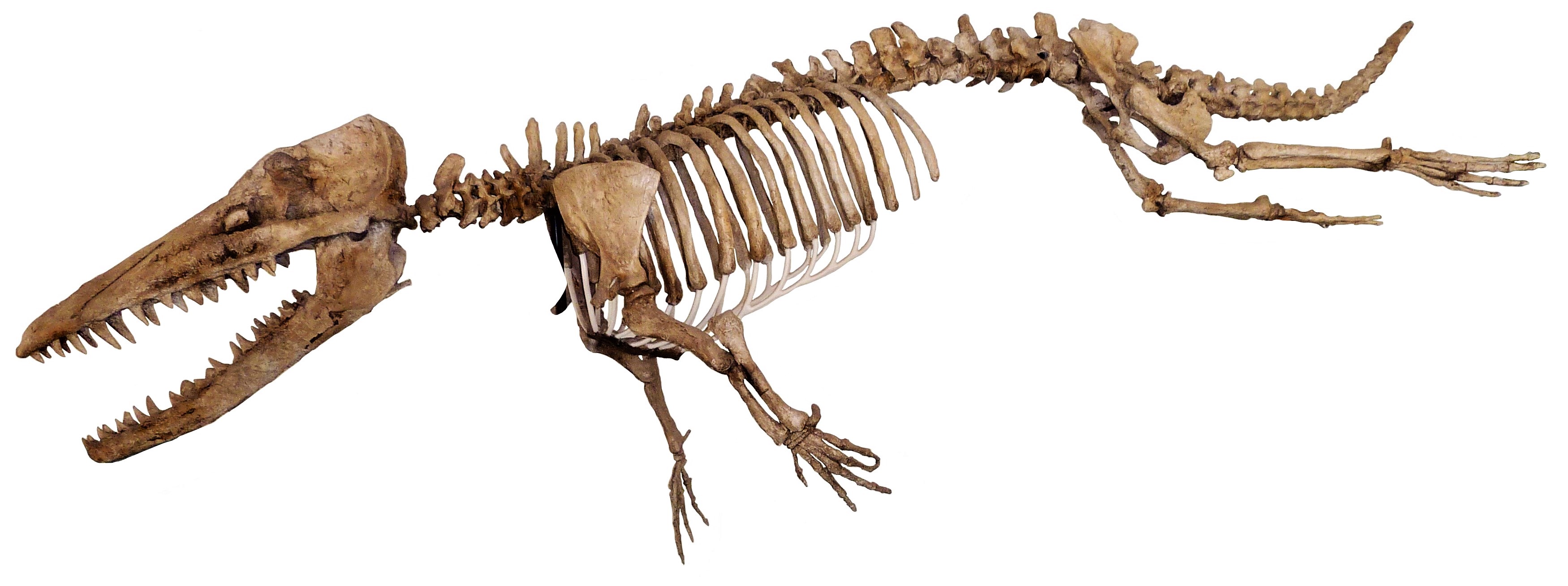
Evidence from the fossil record documenting transitional forms
What Are Transitional Fossils?
Transitional fossils are remains that show an intermediate state between an ancestral form and its descendants. These fossils display traits that are common to multiple taxonomic groups, demonstrating the gradual change from one form to another. They provide direct evidence for macroevolution - large-scale evolutionary transitions between different types of organisms.
Paleontologists have documented thousands of transitional fossils showing major evolutionary transitions. Here are some significant examples:
Fish to Tetrapods
The transition from fish to the first four-limbed vertebrates (tetrapods) is one of the best-documented evolutionary transitions in the fossil record. Learn more about tetrapod evolution on Wikipedia.
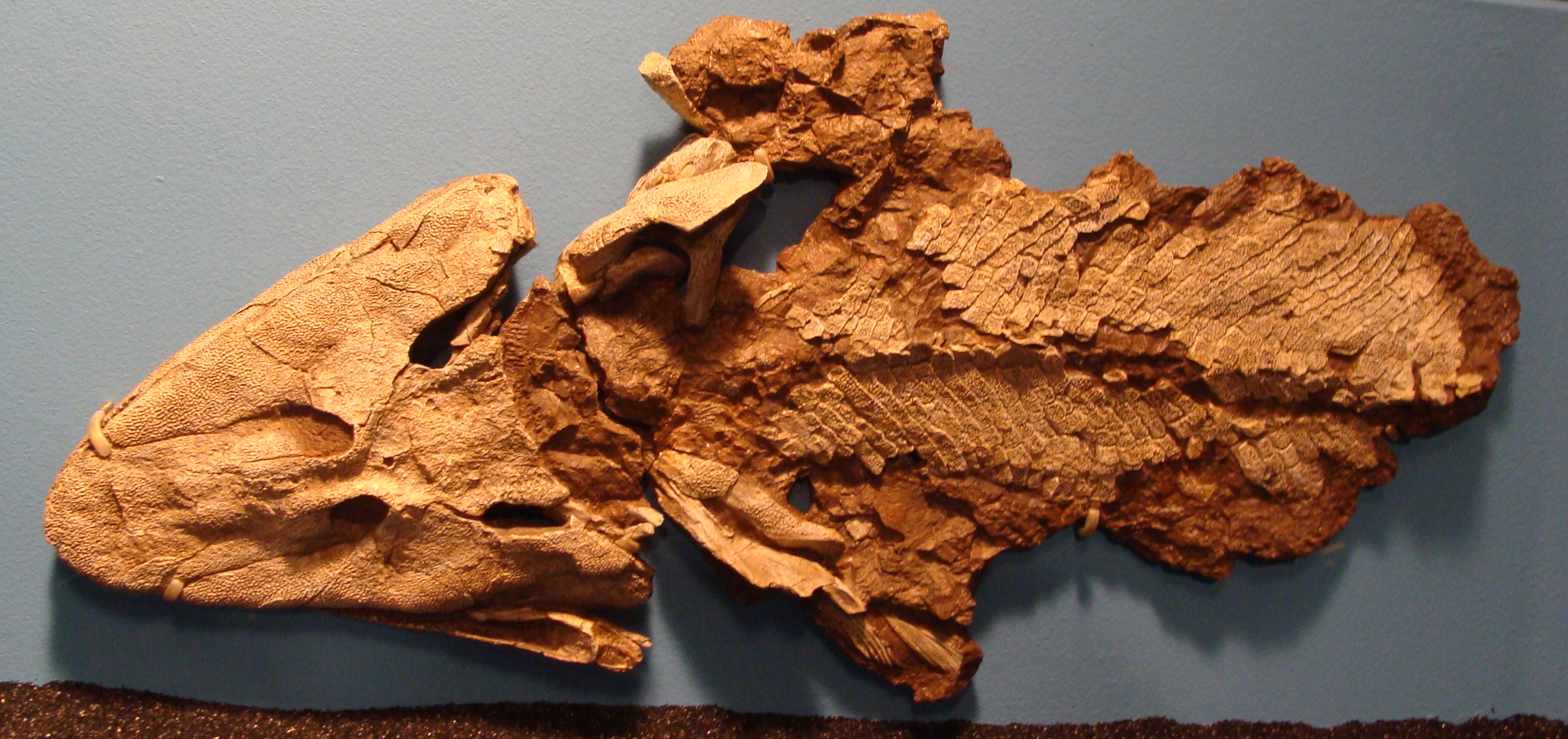
Tiktaalik roseae
The "Fishapod" - Discovered in the Canadian Arctic in 2004, Tiktaalik displays intermediate characteristics between fish and early tetrapods, with features consistent with limb development from fins.
Fish-like scales and gills
Tetrapod-like head with eyes on top of skull
Fin rays but also primitive wrist bones
Capable of "push-ups" with proto-limbs
Age: 375 million years
Acanthostega gunnari
Early Tetrapod - Discovered in Greenland, Acanthostega was one of the earliest tetrapods but retained many fish-like characteristics, showing it was primarily aquatic.
Fully developed limbs with fingers (8 digits per limb)
Functional gills with gill arches
Fish-like tail fin supported by fin rays
Limbs not capable of supporting weight on land
Age: 365 million years
Ichthyostega stensioei
Fish-Tetrapod Transition - One of the first tetrapod fossils discovered, Ichthyostega had more land-adapted features than Acanthostega but still showed clear transitional traits.
Robust limbs with seven digits on hind limbs
Fish-like tail with fin rays
Modified fish skull with ear adapted for hearing in air
Specialized spine for "crutching" locomotion on land
Age: 365 million years
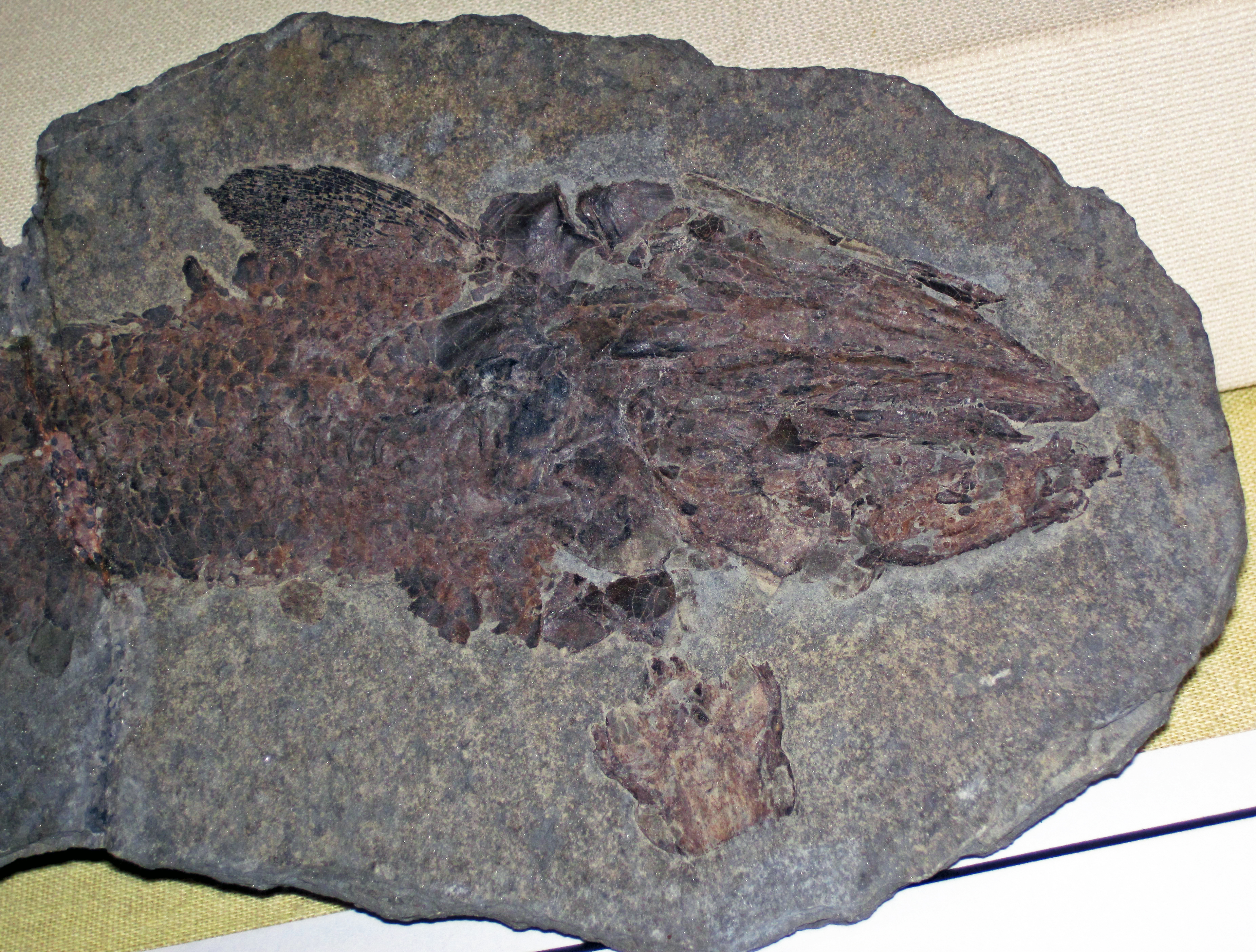
Eusthenopteron foordi
Lobe-finned Fish - Eusthenopteron was a lobe-finned fish that shows early adaptations that would later enable the transition to land, including limb-like fin structure.
Fins with internal skeletal structure similar to tetrapod limbs
Primitive lungs alongside gills
Skull structure showing early tetrapod features
Fully aquatic lifestyle
Age: 385 million years
Dinosaurs to Birds
The evolutionary connection between dinosaurs and birds is one of the most well-documented transitions in the fossil record, with numerous feathered dinosaur fossils discovered in recent decades. Learn more about bird evolution on Wikipedia.
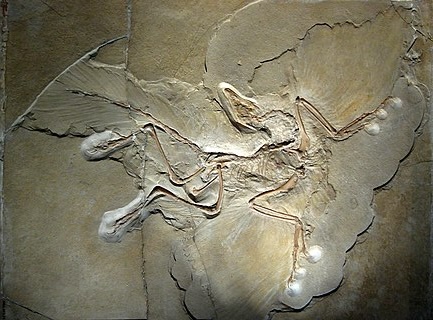
Archaeopteryx lithographica
First Bird-like Dinosaur - Discovered in 1861, Archaeopteryx displays intermediate characteristics between non-avian dinosaurs and modern birds, possessing features of both groups.
Fully developed feathers including flight feathers
Dinosaur-like teeth and long bony tail
Fingers with claws on the wing
No fused wing bones or keeled sternum like modern birds
Age: 150 million years
Microraptor gui
Four-winged Dinosaur - Discovered in China, Microraptor was a small feathered dinosaur with four wings - one pair on its arms and another on its legs, showing an experimental stage in the evolution of flight.
Four wings with asymmetrical flight feathers
Long feathered tail for stability
Typical dinosaur skeletal features
Capable of gliding flight but not powered flight
Age: 120 million years
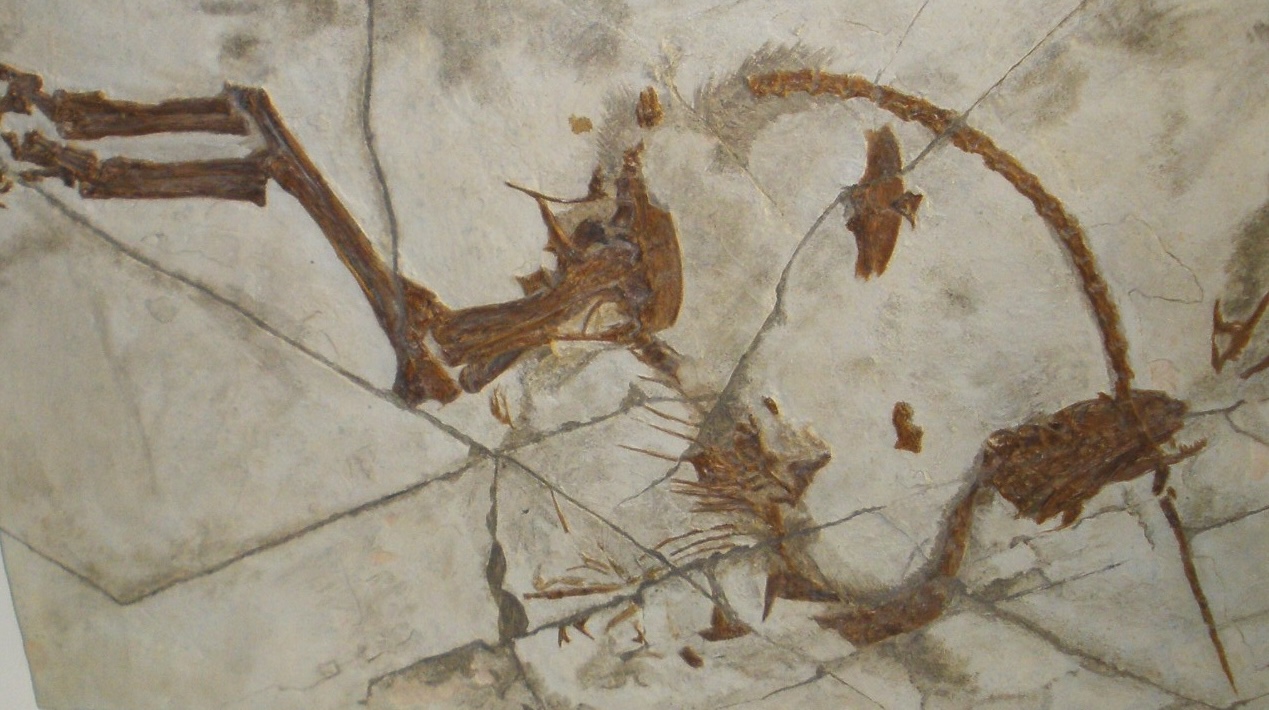
Sinosauropteryx prima
Feathered Dinosaur - The first non-avian dinosaur discovered with evidence of feathers, Sinosauropteryx showed that feathers evolved in dinosaurs long before birds and before flight.
Primitive filamentous feathers along back and tail
Small theropod dinosaur with typical carnivore features
Long tail with 64 vertebrae
Evidence of color pigments in feathers
Age: 124 million years
Confuciusornis sanctus
Early Bird - Confuciusornis was an early bird that shows a mix of primitive and advanced features, representing a stage between Archaeopteryx and modern birds.
Toothless beak unlike earlier birds
Modern-style pygostyle (fused tail vertebrae)
Still had clawed fingers on wings
Long tail feathers in males (sexual dimorphism)
Age: 125 million years
Land Mammals to Whales
The evolution of whales from terrestrial mammals is one of the most dramatic transitions documented in the fossil record, showing how land-dwelling ancestors returned to the sea. Learn more about whale evolution on Wikipedia.
Pakicetus inachus
Early Whale Ancestor - Pakicetus was one of the earliest cetaceans (whale ancestors), showing the first steps of adaptation from land to water. It still looked largely like a land mammal.
Wolf-sized body with four functional legs
Ear region specialized for underwater hearing
Whale-like triangular teeth
Isotope analysis shows it drank freshwater
Age: 50 million years
Ambulocetus natans
"Walking Whale" - Ambulocetus represents a crucial intermediate stage in whale evolution, showing adaptations for both land and water environments. Its name means "walking whale that swims."
Large webbed feet for swimming
Powerful tail for propulsion in water
Nostrils at front of snout (not blowholes yet)
Limbs capable of supporting weight on land
Age: 47 million years
Rodhocetus kasrani
Aquatic Whale Ancestor - Rodhocetus shows further adaptation to aquatic life, with significant changes to its skeleton for efficient swimming, but still retaining functional limbs.
Tail vertebrae show beginnings of flukes
Sacrum (hip vertebrae) no longer fused to pelvis
Nasal opening shifting backward on skull
Ankle bones show relationship to artiodactyls (even-toed ungulates)
Age: 46 million years
Dorudon atrox
Basilosaurid Whale - Dorudon was a fully aquatic whale showing the transition to modern whale body plans while retaining vestigial features of terrestrial ancestry.
Vestigial hind limbs (tiny, non-functional, likely internal to body)
Pelvis detached from vertebral column
Modern-style tail propulsion using flukes
Forelimbs intermediate between land mammals and modern cetaceans
Age: 41-34 million years
Reptiles to Mammals
The evolution of mammals from reptilian ancestors occurred through a group called synapsids. This transition is documented by fossils showing the gradual development of mammalian characteristics over tens of millions of years. Learn more about mammal evolution on Wikipedia.
Dimetrodon
Early Synapsid - Often mistaken for a dinosaur, Dimetrodon actually predates dinosaurs by 40 million years and is more closely related to mammals than to any reptile or dinosaur.
Differentiated teeth (heterodont) with incisors, canines, and shearing teeth
Temporal fenestra (skull opening) characteristic of the synapsid lineage
Reflected lamina on jaw bone, an intermediate feature toward mammalian ear
Transitional nasal cavity structure
Age: 290 million years
Thrinaxodon liorhinus
Advanced Cynodont - Thrinaxodon shows major advances toward mammalian characteristics, including evidence of whiskers (suggesting fur) and a secondary palate for breathing while eating.
Secondary palate allowing simultaneous breathing and eating
Semi-sprawling posture intermediate between reptilian and mammalian
Early Mammaliaform - Morganucodon represents the threshold between reptilian ancestors and true mammals, showing one of the most important transitional features: dual jaw joints.
Dual jaw joints: both reptilian (articular-quadrate) and mammalian (dentary-squamosal)
Middle ear bones transitioning from jaw to hearing function
Small shrew-sized body (skull 2-3 cm)
Evidence of fur and warm-blooded metabolism
Age: 205-200 million years
Conclusion
The examples presented here represent a selection of transitional fossils that have been discovered. These fossils document patterns of species and anatomical change consistent with gradual evolutionary transitions.