For much of the late twentieth century, paleoanthropologists regarded Australopithecus afarensis as the only hominin species inhabiting eastern Africa between roughly 3.0 and 3.7 million years ago. That picture changed dramatically in 2001, when Meave Leakey and colleagues announced a new genus and species, Kenyanthropus platyops, based on a near-complete but heavily distorted cranium from the western shore of Lake Turkana in Kenya.1 The name, meaning "flat-faced human from Kenya," reflects the specimen's most striking trait: a remarkably orthognathic (vertically oriented) midface unlike the projecting snouts seen in most australopithecines.1 Although the taxonomic status of Kenyanthropus remains contested, its discovery opened a sustained debate about species diversity in the middle Pliocene and the branching, rather than linear, nature of human evolution.2, 3
Discovery and context
The Lomekwi site lies on the western side of Lake Turkana in northern Kenya, within the Nachukui Formation, a well-dated sequence of volcanic tuffs and sedimentary layers spanning much of the Pliocene. Fieldwork in this area began in the early 1980s under the direction of the National Museums of Kenya and continued through the late 1990s under Meave Leakey's leadership.4 Between 1982 and 2009, excavations at Lomekwi produced a substantial collection of hominin fossils dated to between 3.5 and 3.2 million years ago, including two partial maxillae, three partial mandibles, a well-preserved temporal bone, forty-four isolated teeth, and the cranium that would become the holotype of the new species.4, 5
In August 1999, research assistant Justus Erus spotted bone fragments eroding from sediments at Lomekwi. The fragments proved to belong to a largely complete cranium, catalogued as KNM-WT 40000.1 The specimen was recovered from deposits bracketed by radiometrically dated tuffs, placing it at approximately 3.5 million years old.1 A year earlier, in August 1998, a partial left maxilla (KNM-WT 38350) had been recovered from Lomekwi Member 17, approximately 17 metres above the Tulu Bor Tuff, and dated to roughly 3.3 million years ago. This maxilla was designated as the paratype of the new species.1, 5
Leakey and colleagues published their formal description in Nature in March 2001, erecting the new genus Kenyanthropus and assigning both KNM-WT 40000 and KNM-WT 38350 to K. platyops. The paper argued that the combination of derived facial features and primitive neurocranial morphology distinguished the Lomekwi specimens from all known australopithecines and warranted a separate genus.1 The announcement attracted immediate international attention, both for the quality of the cranial find and for its implications for hominin diversity in the middle Pliocene.2
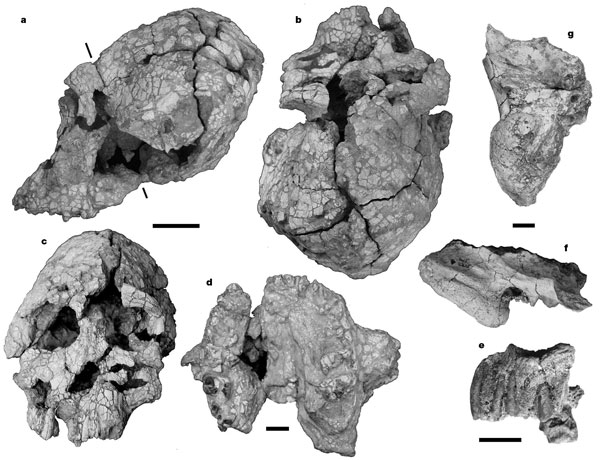
Anatomy and the flat face
The defining feature of Kenyanthropus platyops is its flat, orthognathic midface. In most australopithecines, the subnasal region projects forward (prognathism), giving the face a snout-like profile. By contrast, KNM-WT 40000 displays a subnasal region that is vertically oriented, producing a facial profile more reminiscent of later members of the genus Homo than of contemporary apes or australopithecines.1 The zygomatic processes (cheekbones) are positioned anteriorly, further contributing to the flat facial appearance, and the nasal aperture is relatively tall and narrow.1, 5
The dentition of K. platyops is also distinctive. The molars are remarkably small for a hominin of this age, with the first molar (M1) of the paratype KNM-WT 38350 measuring approximately 10.5 mm mesiodistally by 12.0 mm buccolingually, values that approach the minimum recorded for A. anamensis, A. afarensis, and Homo habilis.1, 5 This combination of a flat face and small teeth contrasts sharply with the large-toothed, prognathic morphology seen in the robust australopithecines (genus Paranthropus) that would appear later in the fossil record.6
The neurocranium of KNM-WT 40000, though distorted, preserves enough morphology to indicate a small brain, broadly comparable in volume to that of other middle Pliocene hominins. The estimated cranial capacity falls in the range of 350 to 450 cubic centimetres, consistent with other australopithecines of the period.1, 7 This combination of a derived face with a primitive braincase is precisely what led Leakey and colleagues to propose that the Lomekwi fossils represented a distinct evolutionary lineage rather than a variant of A. afarensis.1
Comparison of key cranial features across middle Pliocene hominins1, 8, 5
| Feature | A. afarensis | K. platyops | A. africanus |
|---|---|---|---|
| Subnasal prognathism | Marked | Minimal (flat) | Moderate |
| Zygomatic position | Posterior | Anterior | Intermediate |
| Molar size | Moderate to large | Small | Moderate to large |
| Cranial capacity | ~400–550 cc | ~350–450 cc | ~420–510 cc |
| Nasal aperture | Broad | Tall, narrow | Moderate |
The distortion debate
Almost immediately after the 2001 announcement, paleoanthropologist Tim White of the University of California, Berkeley, raised serious concerns about the reliability of the holotype cranium. In a 2003 commentary published in Science, White argued that KNM-WT 40000 had been subjected to severe expanding matrix distortion (EMD), a geological process in which minerals crystallising within the bone cause it to expand, crack, and warp in unpredictable ways.2 The cranium had broken into more than 1,100 fragments, most of them less than one centimetre across, before being painstakingly reassembled.2
White contended that EMD does not enlarge or distort all dimensions equally, producing a complex pattern of deformation that is often impossible to correct for retroactively. He argued that the flat-faced appearance of KNM-WT 40000 could be an artefact of this distortion rather than a genuine anatomical feature, and that the specimen could not be reliably distinguished from A. afarensis or A. anamensis, particularly given the range of cranial variation observed in living apes and humans.2 White recommended a more conservative taxonomy that would sink Kenyanthropus back into Australopithecus.2
Supporters of the new genus responded by pointing to the paratype maxilla KNM-WT 38350, which was not subject to the same degree of distortion but nonetheless shared the diagnostic flat subnasal morphology and small molar size.1, 5 In 2010, Fred Spoor and colleagues published a detailed morphometric reanalysis of the KNM-WT 40000 maxilla in the Philosophical Transactions of the Royal Society B. Using both conventional measurements and geometric morphometric methods, they compared the Lomekwi maxillae with those of other Plio-Pleistocene hominins, modern humans, chimpanzees, and gorillas. Their analysis concluded that the maxillary morphology of KNM-WT 40000 falls outside the range of variation for A. afarensis and supports the recognition of at least two hominin species in the middle Pliocene of eastern Africa.5
The debate has not been fully resolved. Some researchers accept Kenyanthropus as a valid genus; others prefer to classify the Lomekwi specimens as Australopithecus platyops; and a minority follow White in questioning whether the diagnostic features are real at all.3, 9 What is not seriously disputed, however, is that the Lomekwi fossils demonstrate morphological diversity in the middle Pliocene that a single-species model of A. afarensis cannot easily accommodate.5, 10
Middle Pliocene diversity
The naming of Kenyanthropus platyops was the first major challenge to the long-standing view that A. afarensis was the sole hominin occupying eastern Africa during the middle Pliocene (roughly 3.0 to 3.8 million years ago). Before 2001, the only other candidate for a contemporaneous species was Australopithecus bahrelghazali, described from a fragmentary mandible found in Chad in 1995, though many researchers regarded it as an African variant of A. afarensis.11
The case for middle Pliocene diversity was substantially strengthened in 2015, when Yohannes Haile-Selassie and colleagues described Australopithecus deyiremeda from 3.3- to 3.5-million-year-old deposits in the Woranso-Mille area of the Afar region, Ethiopia. The new species was distinguished from A. afarensis by its robust mandible, smaller teeth, and anteriorly positioned zygomatic arch, features that also invited comparison with K. platyops.10 Together, K. platyops, A. deyiremeda, and A. bahrelghazali suggest that at least three or four hominin species may have coexisted across Africa during this interval, fundamentally undermining the linear, single-species model of early human evolution.10, 12
This pattern of diversity echoes what is known from later periods. By 2.0 million years ago, at least three genera of hominins (Australopithecus, Paranthropus, and Homo) coexisted in eastern and southern Africa.6 The Lomekwi evidence indicates that this kind of taxonomic richness extends much further back in time, to periods previously thought to have been dominated by a single lineage.1, 5
Temporal ranges of middle Pliocene hominin species (millions of years ago)1, 8, 10, 11
The Lomekwian stone tools
In 2015, Sonia Harmand and colleagues announced the discovery of stone tools at the nearby site of Lomekwi 3, dated to 3.3 million years ago, making them the oldest known stone artefacts in the world and predating the previously earliest Oldowan tools by approximately 700,000 years.13 The tools, which the discoverers named "Lomekwian" to distinguish them from the later and more refined Oldowan industry, include cores, flakes, and anvils that show evidence of deliberate knapping, though the technique appears to have been less controlled than the standardised flake production seen in the Oldowan.13
The temporal and geographic proximity of the Lomekwian tools to the Kenyanthropus platyops fossils has led several researchers to suggest that K. platyops may have been the maker of these earliest stone tools. The Lomekwi 3 site lies within the same formation and stratigraphic interval as the hominin fossils, and K. platyops is the only hominin species currently known from the immediate vicinity at the relevant time depth.13, 14 However, this attribution remains circumstantial. No tools have been found in direct association with K. platyops skeletal remains, and A. afarensis was also present in the broader East African region at 3.3 million years ago.8, 13
Regardless of which species produced the Lomekwian artefacts, their existence demonstrates that stone tool manufacture began well before the appearance of the genus Homo, which does not appear in the fossil record until approximately 2.8 million years ago.15 This finding has shifted the conversation about the cognitive and manipulative capabilities of middle Pliocene hominins, suggesting that the capacity for intentional stone modification was not unique to our own genus.13
Connection to Homo rudolfensis
One of the most intriguing aspects of Kenyanthropus platyops is its morphological resemblance to KNM-ER 1470, the famous flat-faced skull from Koobi Fora usually attributed to Homo rudolfensis and dated to approximately 1.9 million years ago.16 Both specimens share a flat, orthognathic midface, anteriorly positioned zygomatic roots, and a vertically oriented cheek region, a suite of features that is uncommon among other australopithecines and early Homo species.1, 16
Leakey and colleagues noted these similarities in their original 2001 description and suggested that K. platyops might be ancestral to whichever lineage produced KNM-ER 1470.1 In 2003, the Australian anthropologist David Cameron conducted a cladistic analysis that recovered Kenyanthropus and H. rudolfensis as sister taxa, suggesting they shared a common evolutionary trajectory distinct from the Australopithecus–Paranthropus lineage.17 If this relationship is correct, it would imply that the flat-faced morphology persisted as a coherent lineage for more than 1.5 million years, representing a genuinely separate branch of the hominin family tree.17
Some researchers have taken this logic further and proposed that H. rudolfensis should be transferred to the genus Kenyanthropus, becoming Kenyanthropus rudolfensis. Others have argued the reverse: that K. platyops should be reclassified as an early member of Homo.3, 16 Neither proposal has achieved consensus, but the morphological parallels between the two specimens remain a productive area of research and underscore the complexity of hominin phylogeny during the Pliocene and early Pleistocene.9
Key specimens
The hypodigm (total sample) of Kenyanthropus platyops is relatively modest compared to the extensive collections of A. afarensis, but the available specimens provide important anatomical information. The holotype, KNM-WT 40000, is a near-complete cranium that preserves much of the facial skeleton, the palate, and portions of the neurocranium.1 Despite the severe expanding matrix distortion that broke the specimen into over 1,100 fragments, careful reconstruction revealed the diagnostic flat midface, small dental arcade, and anteriorly placed zygomatic arches.1, 2
The paratype, KNM-WT 38350, is a partial left maxilla preserving the premolar and molar region. Because it was not subject to the same degree of post-depositional distortion as the holotype cranium, it has played a crucial role in the debate over the validity of the genus. Its flat subnasal morphology and small molar dimensions are consistent with the features observed in KNM-WT 40000, providing independent confirmation that the flat face is not purely an artefact of taphonomic distortion.1, 5
Additional material from Lomekwi includes isolated teeth, mandibular fragments, and a well-preserved temporal bone, all recovered from deposits dated between 3.5 and 3.2 million years ago. While not all of these specimens can be confidently assigned to K. platyops (some may represent A. afarensis or another taxon), their overall morphological pattern is consistent with a population that differed from the contemporaneous A. afarensis samples known from Ethiopia.4, 5
Key specimens attributed to Kenyanthropus platyops1, 4, 5
| Specimen | Element | Age (Ma) | Year found | Significance |
|---|---|---|---|---|
| KNM-WT 40000 | Near-complete cranium | ~3.5 | 1999 | Holotype; flat face, small teeth |
| KNM-WT 38350 | Partial left maxilla | ~3.3 | 1998 | Paratype; confirms flat subnasal morphology |
Evolutionary significance
Kenyanthropus platyops matters not because its taxonomic status has been settled but precisely because it has not. The specimen forces paleoanthropologists to confront an uncomfortable reality: the human fossil record in the middle Pliocene is more complex than a simple ladder of ancestor-to-descendant species. Whether classified as a separate genus, a species of Australopithecus, or even an aberrant individual, the Lomekwi cranium documents a morphological signal that does not fit neatly into the A. afarensis lineage.1, 5
The broader implication is that hominin evolution followed a branching, bushy pattern rather than a linear march from ape to human. By 3.5 million years ago, multiple hominin species with different facial structures, dental adaptations, and presumably different ecological strategies occupied the East African landscape.10, 12 Some of these lineages, like the robust australopithecines, would persist for millions of years before going extinct without issue. Others may have given rise to the genus Homo. The challenge for modern paleoanthropology is determining which branches led where, and K. platyops, with its tantalising resemblance to Homo rudolfensis, remains a key piece of that puzzle.1, 17
The association with the world's oldest known stone tools adds a further dimension. If K. platyops or a close relative was responsible for the Lomekwian artefacts, it would demonstrate that technological innovation was not confined to the lineage leading to modern humans but was a more widespread capacity among middle Pliocene hominins.13 This possibility, combined with the growing evidence for dietary and locomotor diversity among contemporaneous species, paints a picture of the middle Pliocene as a period of adaptive experimentation from which our own genus eventually emerged.10, 18